Section 3. Implementation of ADTs in JavaScript]
This section delves into the practical implementation of basic Abstract Data Types (ADTs) within the JavaScript programming language. ADTs, as mathematical models with defined operators, provide a foundation for algorithm development. However, translating these conceptual models into executable code requires representing ADTs using the data types and methods available in JavaScript. We will explore how to bridge the gap between abstract data structures and their concrete JavaScript implementations, demonstrating techniques to effectively utilize JavaScript’s features to realize fundamental ADTs. This section will equip readers with the knowledge to translate theoretical ADT concepts into functional JavaScript code, laying the groundwork for more complex data structure and algorithm implementations.
3.1. Data Structuring Features
In practical terms, a data structure is a collection of data structured in such a way as to ensure efficient use by users. This requires a certain ordering of data, primarily at the level of storage in computer memory. Reducing space and increasing organization in conjunction with reducing the time complexity of different tasks is the main objective of working with data structures.
Considerable experience in the development of computer technology and computing technology has made it possible to classify data structures into different categories. First, simple and integrated structures are distinguished by complexity. The criterion of simplicity is indivisibility — that is, in a computer implementation, a simple chain of bits. Simple, basic structures include variables of different types: integers, real numbers, booleans, strings.
Integrated (composite, complex) structures are data structures whose component parts are other data structures, including simple and integrated. Many basic integrated data structures are predefined by a specific programming language: arrays, slices, structures, etc. Such structures can be created by users for a specific problem, using basic integrated structures.
By way of presentation, data structures are divided into logical and physical. The logical structure is an abstract data layout that the user or programmer envisions. The physical structure is a method (schema) of specific data placement in computer memory. In general, the logical and physical structures of the same data do not coincide. In a logical (abstract) structure, data tend to be adjacent to each other, while in a computer implementation these data may be located in different memory regions.
An important feature of a data structure is the existence of links between its elements. On this basis, we distinguish disconnected and connected structures. Disconnected structures are characterized by a lack of linkages between the elements, while connected structures are characterized by linkages. Disconnected structures include arrays, strings, stacks, queues, and linked lists. In many cases, data can be characterized by variability — that is, a change in the number of elements and/or the relationships between elements of the structure. Arrays, sets, records, tables fall under the category of static data; stacks, queues, trees fall under semi-static data; linked lists and graphs fall under dynamic data.
Linear and non-linear data structures are distinguished by structural order. Linear structures are divided into structures with sequential distribution of elements in memory (vectors, strings, arrays, stacks, queues) and structures with arbitrary connected distribution of elements in memory, depending on the nature of the reciprocal arrangement of elements in memory (singly linked and doubly linked linear lists). Nonlinear structures are multi-linked lists, trees, graphs.
One of the defining features of data structures is how to access data. In the access method, a search mechanism is important — an algorithm that determines the access path possible within a given memory structure, and the number of steps along that path to find the sought data. There are two main groups of data access methods: sequential and direct.
Sequential access means that a group of elements is accessed in a predefined ordered sequence. An example of sequential access is a singly linked list. Direct access, by contrast, means that individual elements of the data structure are accessed directly by providing a unique address for each element.
Finally, one characteristic of data structures is homogeneity. Homogeneous structures contain a set of simple data of the same type (numeric, boolean, string, etc.). Heterogeneous structures combine data of different types. Examples of homogeneous structures are arrays, slices, and stacks. Heterogeneous structures include records and sets.
The presence of a large number of data structure features has predetermined various attempts to classify them. From a programming point of view, the main features are: linearity/non-linearity, data access, and data homogeneity/heterogeneity. This section covers the JavaScript implementation of linear abstract data types such as arrays/slices, maps, linked lists, stacks, and queues.
3.2. Linear Data Structures
Linear data structures are structures in which data elements are arranged in sequence. Linear structures can be distinguished by the way the individual elements of a data collection are accessed and by the homogeneity of the data (homogeneous and heterogeneous).
3.2.1. Arrays in JavaScript
An array is a collection of data where each element is stored at a specific index. Arrays allow efficient storage and manipulation of multiple values in a single variable.
For example, the collection of integers [31, 26, 19, 24, 32, ….35, 41, 14, 33, 29] forms an array (Figure 3.1).

Declaring Arrays in JavaScript
JavaScript arrays are dynamic, meaning they can grow and shrink as needed. Unlike some other languages, JavaScript allows mixing different types within an array, but best practice is to keep arrays homogeneous (storing values of the same type).
Creating Arrays
Arrays in JavaScript can be declared in different ways:
a) Using [] (Recommended)
let numbers = [24, 12, 36, 6, 47, 11];Using the Array Constructor
let numbers = new Array(24, 12, 36, 6, 47, 11);This method is rarely used in modern JavaScript.
3.2.2. Slices
A slice is a variable-length data collection that stores elements of a homogeneous type. A slice can be thought of as a "slice" of an array. Slice syntax in JavaScript is [] or [value1, value2, value3, …, valueN].
In JavaScript, slices are implemented dynamically. To create a slice (array) in JavaScript, you can use an array literal or the Array constructor. For example, creating parentSlice would look like this:
let parentSlice = new Array(20).fill(0); // Creating an array of 20 elements, filled with zeros
sliceA and sliceBThe length property indicates the number of elements in the slice (array). In JavaScript there is no explicit concept of "capacity". Multiple "slices" can be created from a single array using the slice() method or destructuring. For example, to create sliceA and sliceB from parentSlice:
let sliceA = parentSlice.slice(0, 4); // sliceA contains the first 4 elements (indices 0–3)
let sliceB = parentSlice.slice(12, 14); // sliceB contains 2 elements (indices 12–13)
In JavaScript, sliceA will contain elements from index 0 to 3, and sliceB will contain elements from index 12 to 13.
The following functions and methods are used to work with slices (arrays) in JavaScript:
-
push(): Adds elements to the end of the array. If the array size is insufficient, it automatically increases.
-
length: Property that returns the number of elements in the array.
-
slice(): Creates a new array containing a "slice" of the original array.
3.2.3. Objects in JavaScript
In JavaScript, objects serve the same purpose as structures in other programming languages. They allow us to store multiple related values (properties) in a single entity. Objects in JavaScript are flexible and support various ways of creation and manipulation.
JavaScript objects are defined using curly braces {} and consist of key-value pairs.
Creating an Object with Named Properties
let employee1 = {
firstName: "Peter",
lastName: "Wolf",
age: 35,
salary: 20000
};
console.log("Employee 1:", employee1);
Alternative Way: Object Constructor
Another way to create an object is by using the Object constructor.
let employee2 = new Object();
employee2.firstName = "Nick";
employee2.lastName = "Smith";
employee2.age = 49;
employee2.salary = 35000;

console.log("Employee 2:", employee2);
Key Differences
-
The first approach (object literal {}) is more common and recommended.
-
The second approach (new Object()) is used when objects need to be created dynamically.
Creating an Object with a Factory Function
A factory function is a regular function that creates and returns an object.
function createEmployee(firstName, lastName, age, salary) {
return {
firstName,
lastName,
age,
salary
};
}

let emp1 = createEmployee("Peter", "Wolf", 35, 20000);
let emp2 = createEmployee("Nick", "Smith", 49, 35000);

console.log("Employee 1:", emp1);
console.log("Employee 2:", emp2);
Output:
Employee 1: { firstName: 'Peter', lastName: 'Wolf', age: 35, salary: 20000 }
Employee 2: { firstName: 'Nick', lastName: 'Smith', age: 49, salary: 35000 }
Adding Methods to a Factory Function
An object can contain methods (functions inside the object).
function createEmployee(firstName, lastName, age, salary) {
return {
getFullName: () => `${firstName} ${lastName}`,
getSalary: () => salary, // You can read salary
setSalary: (newSalary) => salary = newSalary // You can change salary
};
}

let emp5 = createEmployee("Bob", "Anderson", 50, 30000);

console.log(emp5.getFullName()); // "Bob Anderson"
console.log(emp5.getSalary()); // 30000

emp5.setSalary(35000);
console.log(emp5.getSalary()); // 35000
Output:
Bob Anderson
30000
35000
3.2.4. Map in JavaScript
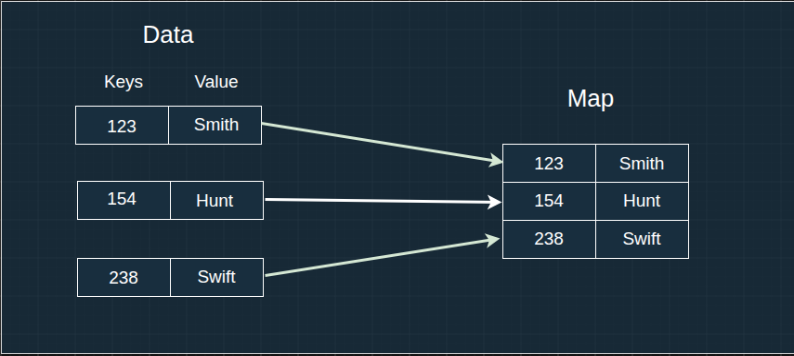
In JavaScript, Maps are collections that store unordered key-value pairs, where each key is unique and maps to a corresponding value. Maps are particularly useful in data retrieval algorithms because they offer efficient lookups.
Unlike arrays, which use numeric indexes, Maps allow keys of any data type, making them more flexible (Figure 3.3).
In JavaScript, we use the Map object to create a map. The syntax is:
let myMap = new Map();Here, myMap is an empty Map ready to store key-value pairs.
Declaring a Map Where Keys Are Strings and Values Are Numbers
We use the .set() method:
let studentScores = new Map();

studentScores.set("Alice", 95);
studentScores.set("Bob", 88);
studentScores.set("Charlie", 92);

console.log(studentScores);
Now, studentScores contains:
-
"Alice" → 95
-
"Bob" → 88
-
"Charlie" → 92
3.2.5. Linked List
A linked list is a dynamic data structure where each element, called a node, consists of two parts (Figure 3.4):
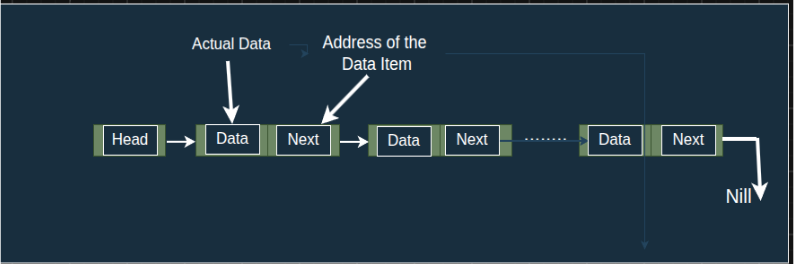
a) Data (which can be any primitive or complex data type) b) A reference (pointer) to the next node in the list
Unlike arrays, where elements are stored in contiguous memory locations, linked lists store elements at different memory addresses and connect them via references.
They are widely used in memory management, file systems, and queue implementations.
In JavaScript, we represent a linked list node using an object.
3.2.6. Stack and Queue as Data Structures
a) Stack
A stack is an abstract data type that contains elements with two basic operations: push, which adds an item to the collection, and pop, which deletes the last item added. From a technological point of view, a stack is memory where data values are loaded and retrieved according to the "Last-In-First-Out" (LIFO) strategy. Data enters the stack from only one side, called the top of the stack (Figure 3.5).

A stack supports two primary operations:
-
Push(item) – adds an element to the top of the stack
-
Pop() – removes the top element from the stack
From a conceptual point of view, a stack can be compared to a stack of plates: you can only remove the top plate. To access a plate further down, you must remove all plates above it.
This structure is commonly used in:
-
Undo (Ctrl+Z) functionality in text editors
-
Managing function calls in recursion (function calls are stored in a stack)
Declaring a Stack in JavaScript
JavaScript does not have a built-in stack data type, but it can be implemented using arrays, as they provide push() and pop() methods.
function createStack() {
let data = []; // Internal storage for stack elements

return {
push(item) {
data.push(item);
},

pop() {
if (data.length === 0) return undefined;
return data.pop();
},

peek() {
return data[data.length - 1]; // View the top element
},

size() {
return data.length;
},

isEmpty() {
return data.length === 0;
}
};
}
b) Queue
A queue is a linear data structure that follows the First-In-First-Out (FIFO) principle. This means that the first element added to the queue is the first one to be removed (Figure 3.6).

A queue supports two primary operations:
a) enqueue(item) – Adds an element to the back of the queue b) dequeue() – Removes an element from the front of the queue
Queues are widely used in:
-
Task scheduling (CPU scheduling, print queue)
-
Breadth-First Search (BFS) algorithms
-
Message processing systems
3.2.7. Representation of Binary Trees in JavaScript
A binary tree in JavaScript can be represented as a set of linked node objects. Each node contains a value and two references: one to the left child and one to the right child. If a child does not exist, the corresponding reference is null. The entire tree is accessed through a reference to its root node.
function createTree() {
    return { root: null };
}

function createNode(value) {
    return {
        value: value,
        left: null,
        right: null
    };
}
This factory-style representation avoids the use of class and this, while keeping the structure simple and explicit. It is convenient for describing algorithms in DRAKON diagrams: operations such as insertion, search, deletion, and traversal can be shown as manipulations of ordinary objects and their left and right links. JavaScript code then directly follows the same logic, creating nodes with a factory function and updating references between them.
3.3. Summary
This section covered the practical realization of fundamental Abstract Data Types (ADTs) in JavaScript, bridging theoretical concepts with concrete implementation techniques.
We examined both linear and non-linear data structures: * Dynamic Arrays and Sets: Leveraging JavaScript’s built-in capabilities and performance tradeoffs. * Linked Lists (Singly and Doubly): Implementing pointer-based structures manually using factory functions and reference manipulation. * Stacks and Queues: Enforcing LIFO and FIFO behavior for operational constraints and algorithmic tasks such as parsing and state traversal. * Binary Trees: Representing hierarchical structures via linked node objects.
By relying on explicit factory functions rather than class-based syntax, these implementations maintain a direct correspondence with visual DRAKON diagrams. This hybrid methodology lays a solid foundation for evaluating memory dynamics, pointer operations, and algorithmic time complexity in subsequent sections.